Thursday, March 14, 2019

Projects in the Capital Improvement Plan Reflect a Need for Equity in Facilities Throughout IWCS

Earlier this week, the school division hosted the Board of Supervisors and the Planning Commission for special tours of Hardy Elementary School and the bus garage. Both facilities have been identified for renovation or replacement in the Isle of Wight County Schools' (IWCS) Capital Improvement Plan (CIP).  The county CIP, which includes the division's requests, is still pending approval by the Planning Commission and final approval by the Board of Supervisors.  


During the 2017-2018 school year, IWCS gathered input from the community to develop a long range plan for facilities.  We held community meetings, conducted surveys, and created a committee comprised of mostly parents to assist us with developing a plan for the future.  They were very clear in their feedback:  Carrollton is too crowded, the bus garage can't accommodate the longer buses, Hardy and Westside need to be renovated to keep all schools to similar standards. 


We have proposed solutions that are fiscally responsible and ensure equity and access for all students.  We paired a renovation for Hardy Elementary school with the addition of 5 classrooms (1 each for K-4).  Rezoning a little over 100 students from Carrollton to Hardy drops Carrollton Elementary's current capacity from 97% to 79% and keeps Hardy around 84%.  To alleviate crowding at Westside, we kept 4th grade at Hardy this year, which removed the need for trailers at Westside and lowered their capacity to 85%.  


While we are anticipating more growth in the Carrollton area, these solutions provide room for additional students and eliminate the immediate need for a new elementary school.  We wouldn't need to look at a new elementary school until the Westside, Carrollton and Hardy reached 95% capacity, which may be way out in the future, if it ever happens.

We have a great plan for Hardy, and not one that is just a band-aid.  The school opened in 1961, and if you walk into Hardy you feel like you've gone back in time to 1961.  The hospital green wall tile, dimly lit hallways, and a multi-purpose room that serves as a gym do not reflect the quality of teachers and students in the building.  People DO judge a book by it's cover.  Look at the outside of both schools.  Look at the gym, the cafeteria, the entrance-way, the bathrooms, for both schools.  With everything else being equal, where does a new family want to send their child to school?  Where are people buying a home?

As we met with both groups, we seemed to be faced with a wide range of opinions--do nothing, scale back the renovation significantly, go with the School Board's recommendation, or completely replace Hardy with a new school. The renovation and addition for Hardy Elementary is $13.4 million.  To replace Hardy would be almost $28 million, not counting land acquisition. The plan approved by the School Board would bring one of our oldest schools up to to modern day standards and address the growth at Carrollton Elementary.  Once again, the recommendations approved by the School Board were developed through an extensive process which involved numerous opportunities for parents and the community to provide input.  The proposal given to the School Board was generated by the Long Range Planning Committee.

We are committed to providing our students with opportunities to be successful in today's world.  We need our facilities to reflect the modern world to better prepare our children their future.


Friday, March 8, 2019

Preparing all Students for a Successful Future

In less than seven days, the school division was involved in two significant events that demonstrate our commitment to preparing students for a successful future.

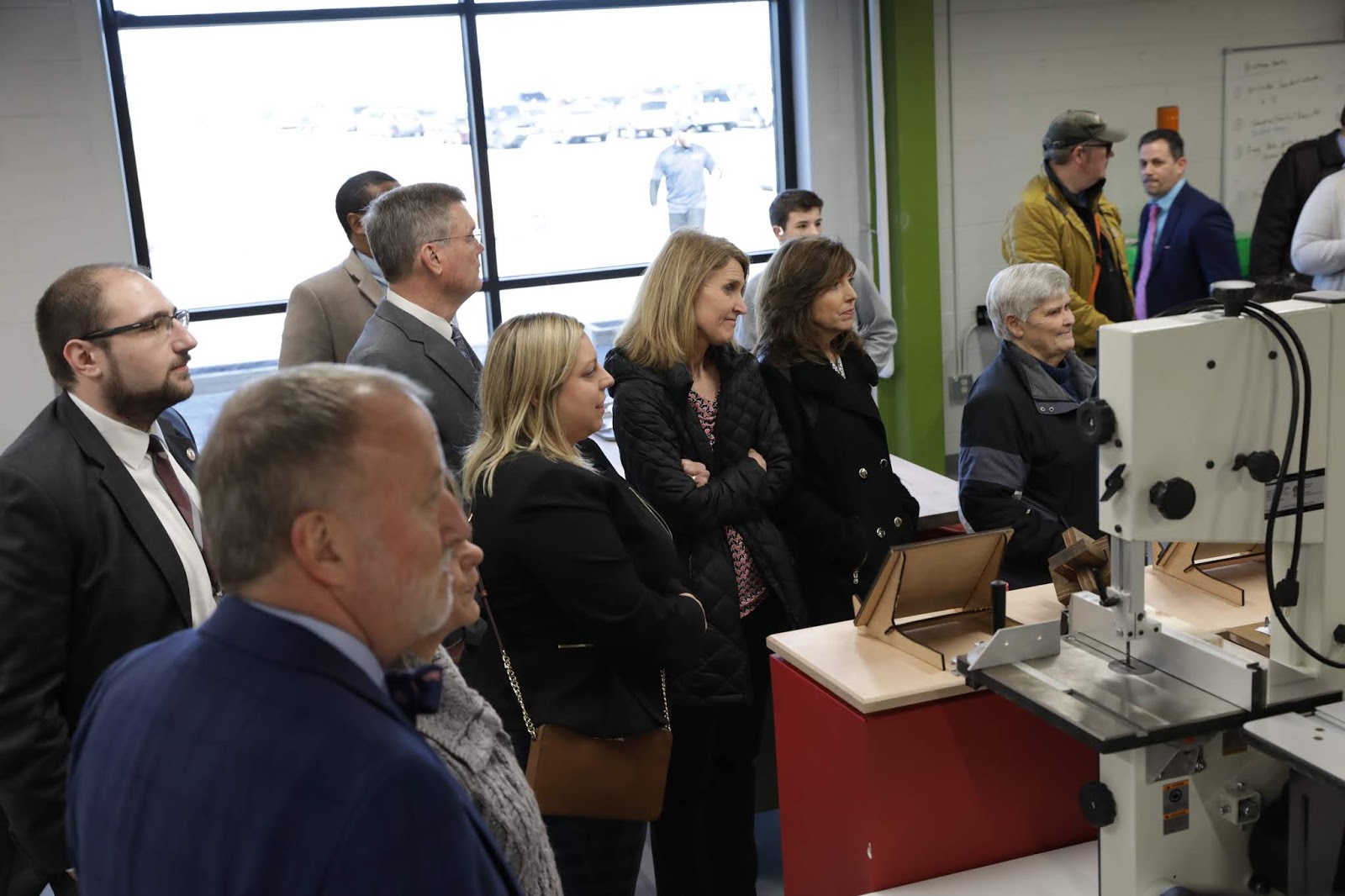
On Wednesday, we officially opened the Career Building at Smithfield High School.  The heavily renovated facility is home to five of our Career and Technical Education (CTE) programs, including welding, nursing, culinary arts, manufacturing and engineering.  Manufacturing and engineering have access to a MakerSpace area, equipped with 3D printers, laser and vinyl cutters, and numerous other devices that allow students to take an idea from concept to finished product.  Engineering also incorporates mechatronics into the curriculum, providing students with hands-on learning for mechanical, electrical and computer systems.  The nursing space is designed as a mock medical facility, complete with beds, mannequins, privacy curtains, diagnostic equipment, and a nurses' station.  Our welding lab uses industry standard equipment to prepare students to be highly qualified candidates for employment.  The culinary arts program is soaring to new heights with a commercial kitchen and student-run restaurant.

I felt like a proud parent as I surveyed each room on our tour of the building. There were looks of amazement from our guests and faces full of joy and confidence from our students.  Students, not teachers, spoke to the visitors about their programs, their spaces, and the skills they are developing.  It gave me goose bumps to see the students not just working in their areas, but comfortably sharing their story with all the guests on hand.  They are mastering those 5 Cs (communication, critical thinking, creativity, collaboration, citizenship) that they need to be successful in any path they choose.

The other event occurred on March 1 and, while it didn't receive the same level of coverage as the ribbon cutting on Wednesday, I consider it equally significant.  Last Friday, the Virginia Secretary of Agriculture and Forestry, Betting Ring, visited our Land Lab to see how we are teaching Ag through authentic learning experiences.  She was impressed with new barn and classroom as well as the variety of animals and plants located at the farm.  But she was most impressed with the students.  They showed her around and explained to her what they've learned by being part of the program.  It was all student driven. She was not there to celebrate the opening of a facility, but rather the way we are providing our students with real-world learning opportunities.  This was an important part of the redesign of our CTE programs. Having leaders at the state level acknowledge our work and consider it a model for other programs only reaffirms our mission.

Both events would not have been possible without the support of several key groups and organizations.  We are grateful to Smithfield Foods and CEO Ken Sullivan, and the Smithfield Foundation, for donating $3million to establish the Smithfield Legacy project.  The project supports our commitment to preparing students to be college, career and life ready.  The Legacy Project funded the construction of a dedicated facility for JROTC, and the renovation and installation of a state-of-the-art MakerSpace facility in the Career Building, and will support a global logistics program slated for 2020. We also appreciate the financial commitment from the Isle of Wight Board of Supervisors, who believed in our vision and understood the importance of providing opportunities for all of our students, not just those going to college after high school.  Because of the support of our School Board, the Board of Supervisors, the business community, and Smithfield Foods, our students will be sought-after candidates for high skill, high wage, high demand jobs.

I've included a round-up of media coverage from both events. I'm also posting a few pictures below.  The images capture the remarkable accomplishments we had only envisioned a few years ago.  While the journey isn't over, I know that the pathways we are creating will equip our students with the skills needed for a successful future.

Links to the Career Building Grand Opening

WAVY News 10:  State-of-the-Art Career Center Unveiled at Smithfield High

Daily Press Video:  Smithfield High Vocational Training

Daily Press: Smithfield High's New Career Facility Includes Restaurant and MakerSpace  

WVEC 13 News Now:  Smithfield High School Opens New Career Center

Suffolk News Herald:  New Career Building Unveiled at SHS 

Global News Wire:  Smithfield Foods Unveils New Career Building at Smithfield High School 


Links to the Secretary of Agriculture's Visit to the IWCS Land Lab

Virginian Pilot:  Isle of Wight's Student-Run Farm Welcomes State Agriculture and Forestry Secretary

Daily Press Video:  Virginia Secretary of Agriculture and Forestry Bettina Ring Visits Isle of Wight's Student Farm

Check out our Facebook and Twitter feeds for more pictures from both events.


Friday, February 15, 2019

What is your Return on Investment from IWCS?

Return on Investment, or ROI, is defined as the benefit of the investment versus the cost of the investment.  Each year, the citizens of Isle of Wight County make a significant investment in Isle of Wight County Schools.  How is that money being used?  What benefits have been realized from taxpayer funding?  The following video answers those questions and shows you the results of your investment in Isle of Wight County Schools.  We appreciate your support of IWCS  and promise to continue delivering a high return on investment to the residents of Isle of Wight County.


Saturday, February 9, 2019

February is School Board Appreciation Month


February 2019 has been designated as School Board Appreciation Month in Virginia. The theme — Leading for Success — reflects the top priority of local school board members as they advocate for public education with local, state, and federal leaders on behalf of all students.

As citizen leaders, school board members face complex and demanding challenges. Yet few people fully understand the scope and far reaching implications of board members’ responsibilities. Virginians should recognize the vital contributions of these men and women and focus attention on the crucial role these elected public officials play in the education of our children. Their job is to establish a vision for the education program, design a structure to achieve that vision, ensure schools are accountable to the community and strongly advocate continuous improvement in student learning.


That job entails an endless string of meetings and school functions to attend; reams of reports, agendas, proposals and other information to read and study; and a host of difficult decisions to make. Although they wear many hats in the workday world, school board members put on a collective hat when they get down to the business of leading their school divisions. Board members must pull together as a team toward a common goal of helping all students achieve. Though individual school board members may sometimes disagree on issues, their role as a member of the school board is to consistently strive toward the goal of high academic achievement. Working together, school board members speak out for public schools and the students they serve.

Board members contribute hundreds and hundreds of hours each year leading their divisions. Whether it is crafting policies, hiring top-notch administrators, listening to staff and student concerns or recognizing outstanding programs, board members always keep their eyes on the goal of student achievement.

The time spent in board meetings represents just a small fraction of the hours school board members spend leading in their divisions. They also work hard at seminars and training sessions to keep abreast of the latest trends in educational leadership, are deeply involved in community activities and spend many hours in the schools and at extracurricular events. Their love for learning, and concern and caring for students, staff and community, drives board members’ desire to lead so students can achieve.

In recognition of the dedicated service of school board members throughout Virginia, February has been designated as School Board Appreciation Month. This is the time to show our recognition and to increase our understanding of how local board members work together to provide a better future for our children. Please join me in saluting our board members who provide grassroots governance of public schools. I encourage each of you to make a special effort to tell each school board member that their hard work has been noticed and is truly appreciated.

Vicky Hulick, Chairman, Newport District        
Jackie Carr, Vice-Chairman, Carrsville District 
Kirstin Cook, Smithfield District        
Julia Perkins, Windsor District      
Alvin Wilson, Hardy District


Friday, January 25, 2019

Inspiring a Love for Musical Instruments in Elementary School

Our vision in Isle of Wight County Schools is to create a learning environment that will enable every child to discover his or her unique gifts and talents.  This year, three of our elementary schools are introducing students to instruments through their music classes.  Carrsville Elementary is redefining itself as an integrated arts school and, in September, they launched a unique music program.  All students, beginning with kindergarten, spend 30 minutes every day learning to play the violin.  Holding the violin and the bow properly, reading music, and playing the notes are just some of what the students are mastering. I am extremely impressed with the progress the students are making in such a short time.  Windsor Elementary expanded their music program this year with the addition of keyboards during their music resource time.  The students are enthusiastic and excited to not just sing music, but to play selections on the keyboard, including some created by the students themselves.   Carrollton Elementary recently added guitars to their music program, thanks to a Donors Choose grant.  Smithfield High student Lily Eng works with the Carrollton music classes on Friday and came up with the idea for a grant for guitars. Now students are learning to play an instrument as part of their music class.

While teaching students to play a musical instrument is the primary goal of both programs, there are many additional benefits for our young learners. Studies show that learning a musical instrument reduces feelings of anxiety, builds greater control of emotions and improves focus. It also builds grit and determination. Even if students don't continue studying an instrument when they leave elementary school, the skills they acquire will assist them for years to come.

I encourage you to watch the video below and hear from the students and teachers on the positive impact these programs are having. "Bravo" to these students for their enthusiasm and tenacity as they expand their musical horizons.

Violins! Pianos! Guitars! OH MY! (video)

Monday, January 14, 2019

Delivering Effective Instruction using the Instructional Framework

Isle of Wight County Schools developed the Instructional Framework as a way to ensure effective instruction throughout the division.  It is the teacher's responsibility to frame the lesson, allow students to practice targeted skills, integrate projects, pursue their interests, and connect their curriculum to the world beyond school.  Based on best practices, the Instructional Framework follows the gradual release of student learning which moves classroom instruction from teacher-centered, whole group delivery, to student-centered collaboration and independent practice.  The gradual release model incorporates "I do, we do, you do together, you do independently."

Daily lessons include time for identifying the Learning Outcomes or Essential Question, which drive students to discuss, inquire and investigate the topic.  Direct Instruction is the "I Do" part of the lesson, where the teacher is working with the whole class, introducing a concept or activity, or even modeling procedures for the students.  The Student Work Period is the "We Do, You Do Together, You Do Independently" part of the lesson.  This may include stations rotations, collaborative activities, partner or small group work, and field experiences.  The final component of the Instructional Framework is the Debrief, where students and teachers reflect on learning and use that feedback to drive instruction.

The largest chunk of time is devoted to the Student Work Period--65%--with Direct Instruction around 20% and the Debrief at 10%.  Even though Debrief is a small portion of the lesson, it is a valuable component that provided insight into student progress and helps teachers know how to move forward with their instruction.

Recently we spoke to teachers at Carrollton Elementary to find out why the Instructional Framework is beneficial and how their lessons look when they are using the Instructional Framework.  In the video below, the teachers explain how they are using the Instructional Framework in their classroom, while footage from their classes shows the framework in action. I would like to thank the Carrollton teachers for helping us share with the community how classrooms across IWCS are ensuring effective instruction through the use of the Instructional Framework.


Friday, January 4, 2019

Celebrating the Grand Opening of the Barn and Classroom Building at the Land Lab

December 5 was a memorable day. Not just because of the snow we saw in Isle of Wight County, but because we hosted a ribbon cutting ceremony at the new barn and classroom building at the Land Lab.  I was unfortunately under the weather and on doctor's orders for bed rest.  It was incredibly difficult to not be there, but I'm extremely proud of everyone involved for putting together an outstanding event.
The ceremony took place inside of the barn, complete with stalls of goats and piglets, and even some boxes of rabbits.  The event included remarks from our School Board Chairman, Vicky Hulick, and the Vice-Chairman for the Board of Supervisors, William McCarty.  Gracie Owney, a senior from Smithfield High and a student in the Agriculture program, also spoke to the guests about what the program means to her. Mike Lombardo, our Assistant Superintendent, shared the following on my behalf:
Three years ago the division embarked on an ambitious journey to redesign the CTE program to better meet the needs of our students.  The Agriculture program has been a part of the IWCS curriculum for decades, but we knew it needed to be updated.  In the 2016-2018 school year, we established a working farm (Land Lab) to expand the existing agricultural program. The land lab was constructed on existing division property behind Windsor Elementary School.   We hired a full-time farm manager for the Land Lab.  The farm manager and agriculture teacher collaborate to provide authentic real-world learning in the areas of agricultural business management and mechanization, along with plant, animal, and soil science.  Since opening in September of 2017, the students have transformed the Land Lab from six acres of uncut grass, to four fenced pastures, a vegetable garden, and housing for chickens, rabbits, goats, and, as of yesterday, pigs. Students receive real world experiences through the Land Lab, such as participation in “farm to table” marketing from the sale of farm products to the public and to the division’s culinary arts program.  The lab has welcomed groups of elementary students as teachers introduce science standards in their classes.  The working farm has made agriculture come to life for students throughout the division.  And now we have these two beautiful buildings to further enhance learning opportunities for our students.


The strides we have made with this program, many of our CTE programs, would not have been possible without the support and involvement of several key people and groups. The Isle of Wight County School Board had the courage and foresight to see the need for a redesign our CTE program. The Board of Supervisors listened to our proposal and publicly supported our vision for our schools with 7.9 million dollar investment.  Our Farm Manager, Daniel Judkins, and Agriculture teacher, Jason Brittle, and the leadership at our two high schools, Principal Laura Sullivan from Windsor High and Zachary Haney from Smithfield High.  We emphasize the importance of collaboration with our students.  The success of our new CTE model would not have been possible without this collaboration and I wanted to acknowledge their contributions this morning.


All of the speakers, along with Jason Brittle, Daniel Judkins, Zachary Haney and Laura Sullivan, joined together to cut the blue ribbon, officially opening the barn and classroom building for use.  As guests toured the facilities, they were able to enjoy refreshments provided by the IWCS Culinary Arts students and instructor Kyle Cousins.

This was really a milestone for our CTE program.  We are redesigning our courses to provide students with authentic learning experiences.  In order to meet that goal, we have to include facilities that realistically simulate those work environments.  These new buildings at the Land Lab do just that and continue to support our vision of ensuring students are college, career and life ready.

I encourage you to click on the link below to watch a video of pictures from the event.